Saturday, June 29, 2019

Robust Visual-Aided Autonomous Takeoff, Tracking, and Landing of a Small UAV on a Moving Landing Platform for Life-Long Operation


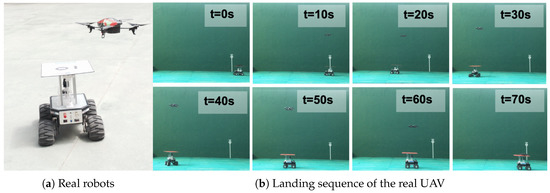
Robot cooperation is key in Search and Rescue (SaR) tasks. Frequently, these tasks take place in complex scenarios affected by different types of disasters, so an aerial viewpoint is useful for autonomous navigation or human tele-operation. In such cases, an Unmanned Aerial Vehicle (UAV) in cooperation with an Unmanned Ground Vehicle (UGV) can provide valuable insight into the area. To carry out its work successfully, such as multi-robot system requires the autonomous takeoff, tracking, and landing of the UAV on the moving UGV. Furthermore, it needs to be robust and capable of life-long operation. In this paper, we present an autonomous system that enables a UAV to take off autonomously from a moving landing platform, locate it using visual cues, follow it, and robustly land on it. The system relies on a finite state machine, which together with a novel re-localization module allows the system to operate robustly for extended periods of time and to recover from potential failed landing maneuvers. Two approaches for tracking and landing are developed, implemented, and tested. The first variant is based on a novel height-adaptive PID controller that uses the current position of the landing platform as the target. The second one combines this height-adaptive PID controller with a Kalman filter in order to predict the future positions of the platform and provide them as input to the PID controller. This facilitates tracking and, mainly, landing. Both the system as a whole and the re-localization module in particular have been tested extensively in a simulated environment (Gazebo). We also present a qualitative evaluation of the system on the real robotic platforms, demonstrating that our system can also be deployed on real robotic platforms. For the benefit of the community, we make our software open source.


I would like to thank Pablo R. Palafox, Mario Garzón and João Valente to give me the opportunity to collaborate with them and get this publication.

P.R. Palafox, M. Garzón, J. Valente, J.J. Roldán and A. Barrientos. Robust Visual-Aided Autonomous Takeoff, Tracking and Landing of a small UAV on a Moving Landing Platform for Life-Long Operation. Applied Sciences, 9 (13), 2661, 2019. Impact Factor (2018): 2.217, Q2. Article

Wednesday, June 12, 2019

SUREVEG Project: Developing robots for strip-cropping systems

The SUREVEG project proposes the development and application of new organic cropping systems using strip-cropping and fertility strategies to improve resilience, system sustainability, local nutrient recycling and soil carbon storage. The project has three main goals: 1) Designing and testing strip-cropping systems in vegetable producing countries at different geographical locations in Europe, 2) Developing and testing soil-improvers and fertilizers based on pre-treated organic plant residues, and 3) Developing and testing smart technologies for management of strip-cropping systems.

The Technical University of Madrid and the Centre for Automation and Robotics are involved in the third goal: Smart machinery for strip-cropping systems. This work aims at developing a robotic tool for the automation of field operations in strip-cropping systems, including the adequate sensors to collect valuable data and actuators to apply precise fertilization. Specifically, it comprises four goals: 1) Designing a multi-purpose robotic tool, 2) Developing sensing systems and algorithms, 3) Developing an actuation system, and 4) Implementing motion planning strategies.

Here you can see the first prototype (I have worked on the manipulator robot):


Friday, May 10, 2019

A training system for Industry 4.0 operators in complex assemblies based on virtual reality and process mining


Industry 4.0 aims at integrating machines and operators through network connections and information management. It proposes the use of a set of technologies in industry, such as data analysis, Internet of Things, cloud computing, cooperative robots, and immersive technologies. This paper presents a training system for industrial operators in assembly tasks, which takes advantage of tools such as virtual reality and process mining. First, expert workers use an immersive interface to perform assemblies according to their experience. Then, process mining algorithms are applied to obtain assembly models from event logs. Finally, trainee workers use an improved immersive interface with hints to learn the assemblies that the expert workers introduced in the system. A toy example has been developed with building blocks and tests have been performed with a set of volunteers. The results show that the proposed training system, based on process mining and virtual reality, is competitive against conventional alternatives. Furthermore, user evaluations are better in terms of mental demand, perception, learning, results, and performance.


J.J. Roldán, E. Crespo, A. Martín-Barrio, E. Peña-Tapia and A. Barrientos. A training system for Industry 4.0 operators in complex assemblies based on virtual reality and process mining. Robotics and Computer-Integrated Manufacturing, 59, 305-316, 2019. Impact Factor (2018): 3.464, Q1. Article.

Wednesday, April 10, 2019

Showing our robots in IRM2019

I have taken part in the stand of the Robotics and Cybernetics Research Group (RobCib) in the Industriales Research Meeting (IRM2019), an event organized by the Industrial Engineering School of the Technical University of Madrid to disseminate the research. In this stand, we have shown the different robots of the group: a mobile manipulator, three search and rescue robots and a hyper-redundant robot. Additionally, we took some volunteers to test our virtual reality interface for monitoring the state of a smart city.


Thursday, April 4, 2019

Workshop: how to tell my research in radio and TV

I attended the workshop "how to tell my research in radio and TV", organized by the Scientific Culture Unit of the Technical University of Madrid. In this course, I learned how to deal with journalists, tell my research to the general public and take part in radio and TV programs.  Moreover, we did a series of short TV interviews and a complete radio program. A great experience!


Friday, March 15, 2019

PerCom 2019: IEEE International Conference on Pervasive Computing and Communications

After an amazing trip through Japan, I have participated in the PerCom 2019: IEEE International Conference on Pervasive Computing and Communications. This conference focused on Pervasive Computing and Communications is organized yearly by IEEE and this time has been celebrated in Kyoto. In particular, I have presented our work "SwarmCity Project: Can an Aerial Swarm Monitor Traffic in a Smart City?" in the UNAGI'19 Workshop on UNmanned aerial vehicle Applications in the smart city: from Guidance technology to enhanced system Interaction. Our paper presents a behavior-based algorithm to allow an aerial swarm to perform surveillance tasks in a city, as well as a data fusion algorithm to build traffic maps from the cars detected by the drones. 


J.J. Roldán, P. Garcia-Aunon, E. Peña-Tapia and A. Barrientos. "SwarmCity Project: Can an Aerial Swarm Monitor Traffic in a Smart City?". UNAGI'19: Workshop on UNmanned aerial vehicle Applications in the smart city: from Guidance technology to enhanced system Interaction. PerCom 2019: 2019 IEEE International Conference on Pervasive Computing and Communications. Kyoto, 11-15th March 2019.

Monday, January 28, 2019

PhD graduation ceremony

This morning it took place the Santo Tomás de Aquino celebration at the Technical University of Madrid, where the new doctors were invested and the university awards were delivered. In this academic act, I promised to act correctly as a doctor and I received my PhD diploma and ring from the university authorities. As you can see, this celebration follows an old tradition and gives rise to curious images...