Showing posts with label UAV. Show all posts

Saturday, June 29, 2019

Robust Visual-Aided Autonomous Takeoff, Tracking, and Landing of a Small UAV on a Moving Landing Platform for Life-Long Operation


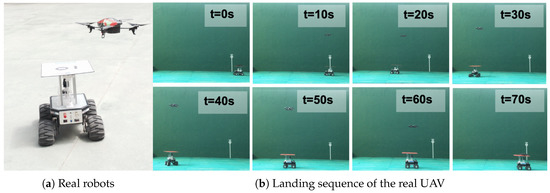
Robot cooperation is key in Search and Rescue (SaR) tasks. Frequently, these tasks take place in complex scenarios affected by different types of disasters, so an aerial viewpoint is useful for autonomous navigation or human tele-operation. In such cases, an Unmanned Aerial Vehicle (UAV) in cooperation with an Unmanned Ground Vehicle (UGV) can provide valuable insight into the area. To carry out its work successfully, such as multi-robot system requires the autonomous takeoff, tracking, and landing of the UAV on the moving UGV. Furthermore, it needs to be robust and capable of life-long operation. In this paper, we present an autonomous system that enables a UAV to take off autonomously from a moving landing platform, locate it using visual cues, follow it, and robustly land on it. The system relies on a finite state machine, which together with a novel re-localization module allows the system to operate robustly for extended periods of time and to recover from potential failed landing maneuvers. Two approaches for tracking and landing are developed, implemented, and tested. The first variant is based on a novel height-adaptive PID controller that uses the current position of the landing platform as the target. The second one combines this height-adaptive PID controller with a Kalman filter in order to predict the future positions of the platform and provide them as input to the PID controller. This facilitates tracking and, mainly, landing. Both the system as a whole and the re-localization module in particular have been tested extensively in a simulated environment (Gazebo). We also present a qualitative evaluation of the system on the real robotic platforms, demonstrating that our system can also be deployed on real robotic platforms. For the benefit of the community, we make our software open source.


I would like to thank Pablo R. Palafox, Mario Garzón and João Valente to give me the opportunity to collaborate with them and get this publication.

P.R. Palafox, M. Garzón, J. Valente, J.J. Roldán and A. Barrientos. Robust Visual-Aided Autonomous Takeoff, Tracking and Landing of a small UAV on a Moving Landing Platform for Life-Long Operation. Applied Sciences, 9 (13), 2661, 2019. Impact Factor (2018): 2.217, Q2. Article

Sunday, June 11, 2017

JNR2017: Jornadas de Robótica 2017


I have taken part in the Jornadas Nacionales de Robótica that took place in Valencia on June 8-9th 2017. I have presented the PRIC Project, which is about the use of robots to protect critical infrastructures and is being developed by my research group.

He participado en las Jornadas Nacionales de Robótica que tuvieron lugar en Valencia el 8 y 9 de junio de 2017. He presentado el Proyecto PRIC (Protección Robotizada de Infraestructuras Críticas), que está siendo desarrollado por la gente de mi grupo de investigación.

J.J. Roldán, M. Garzón, J. de León, D. Garzón-Ramos, A. Martín-Barrio, S. Terrile, P. García-Aunon, J. del Cerro, C. Rossi and A. Barrientos. Proyecto PRIC: Protección Robotizada de Infraestructuras Críticas. Jornadas Nacionales de Robótica. Valencia, June 8-9th 2017. Article

Sunday, May 28, 2017

ROSBook2: A chapter about ROS in Multi-robot Systems


We have contributed with a chapter to the book Robot Operating System (ROS): The Complete Reference (Volume 2). Our chapter is entitled Using ROS in Multi-robot Systems: Experiences and Lessons Learned from Real-World Field Tests and describes our experiences with ROS and multi-robot missions in areas such as surveillance, environmental monitoring, agriculture...

Hemos contribuido con un capítulo al libro Robot Operating System (ROS): The Complete Reference (Volume 2). Nuestro capítulo se titula Using ROS in Multi-robot Systems: Experiences and Lessons Learned from Real-World Field Tests y describe nuestras experiencias con misiones multi-robot y ROS en áreas como la vigilancia, monitorización ambiental, agricultura... 

M. Garzón, J. Valente, J. J. Roldán, D. Garzón-Ramos, J. de León, A. Barrientos and J. del Cerro. Using ROS in Multi-robot Systems: Experiences and Lessons Learned from Real-World Field Tests. Robot Operating System (ROS), Volume 2, pp. 449-483. Springer International Publishing, 2017.

Tuesday, December 13, 2016

Explaining our research in TV and radio


We had the chance to explain our research in robotics applied to greenhouses in radio and TV.

Hemos tenido la oportunidad de explicar nuestra investigación de robótica en invernaderos en radio y televisión.

Reportaje en televisión / TV report:

La Aventura del Saber - RTVE La 2 (47:00)

NCI Universidad Iberoamericana - ibe.tv (4:00)

Entrevista en la radio / Radio interview:

Onda Agraria - Onda Cero (12:30)


Thursday, December 1, 2016

Our research in press


Our research about robot teams in greenhouses has been mentioned by the press.

Nuestra investigación sobre equipos de robots en invernaderos ha sido mencionada por la prensa.

Noticias en español:

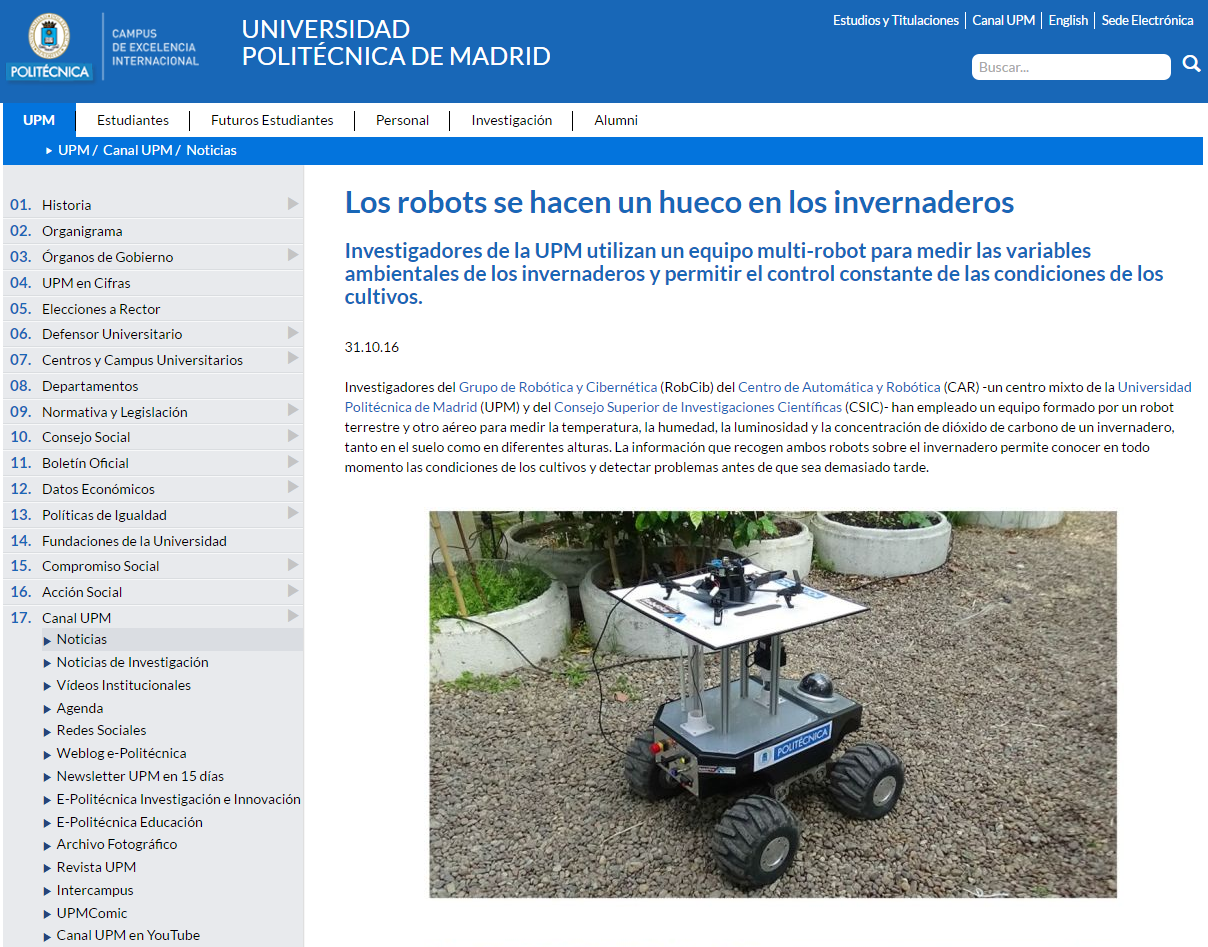
Los robots se hacen un hueco en los invernaderos - UPMmadri+dAlphaGalileoSeedQuest

Dos robots trabajan juntos en el invernadero - Agencia Sinc,

Investigadores crean un robot para el control de cultivos en invernaderos - Europa PressEl Economista, La VanguardiaTelecinco, Cuatro

News in english:

Robots gain a foothold in greenhouses - UPMAlphaGalileoSeedQuest

Friday, July 10, 2015

Our research in press


Our research about robotics applied to greenhouse farming has been collected by the press.

Nuestra investigación sobre robótica aplicada a agricultura en invernadero ha sido recogida por la prensa.

Noticias en español:

Un dron para llenar nuestras despensas - UPM

Un dron permite mejorar la monitorización de los cultivos en invernaderos - RTVE 

Un dron para llenar nuestras despensas - madri+d

Un dron permite controlar el clima y la monitorización de cultivos - sinc

Investigadores de la UPM utilizan un dron para asegurar las condiciones en los invernaderos - EFE verde

El dron "agricultor" es posible - El Economista

Drones para controlar el clima de los invernaderos - ABC

Un artefacto volador dentro del invernadero - La Voz de Almería

News in english:

Using drones for better crops - UPM

Using drones for better crops - Science Daily

Drones to improve monitoring of greenhouse crops - Hortidaily

Using drones for better crops - Science 2.0

Monday, February 2, 2015

Mini-UAV Based Sensory System for Measuring Environmental Variables in Greenhouses


This paper describes the design, construction and validation of a mobile sensory platform for greenhouse monitoring. The complete system consists of a sensory system on board a small quadrotor (i.e., a four rotor mini-UAV). The goals of this system include taking measures of temperature, humidity, luminosity and CO2 concentration and plotting maps of these variables. These features could potentially allow for climate control, crop monitoring or failure detection (e.g., a break in a plastic cover). The sensors have been selected by considering the climate and plant growth models and the requirements for their integration onboard the quadrotor. The sensors layout and placement have been determined through a study of quadrotor aerodynamics and the influence of the airflows from its rotors. All components of the system have been developed, integrated and tested through a set of field experiments in a real greenhouse. The primary contributions of this paper are the validation of the quadrotor as a platform for measuring environmental variables and the determination of the optimal location of sensors on a quadrotor.

Este artículo describe el diseño, construcción y validación de una plataforma móvil de sensores para la monitorización de invernaderos. El sistema completo consta de un sistema sensorial a bordo de un pequeño cuadrirrotor (es decir, un UAV con cuatro rotores). Los objetivos de este sistema incluyen tomar medidas de temperatura, humedad, luminosidad y concentración de CO2 y construir mapas de estas variables. Estas características pueden permitir el control del clima, la monitorización de los cultivos o la detección de fallos (por ejemplo, roturas en las cubiertas de plástico). Los sensores se han seleccionado considerando los modelos de clima y crecimiento de plantas y los requisitos para su integración en el cuadricóptero. El diseño y colocación de los sensores se ha determinado a través de un estudio de la aerodinámica del cuadrirrotor y la influencia de los flujos de aire de sus rotores. Todos los componentes del sistema han sido desarrollados, integrados y probados mediante una serie de experimentos en un invernadero real. Las contribuciones más importantes de este artículo son la validación del cuadricóptero como plataforma para medir variables ambientales y la determinación de la localización óptima de los sensores en el mismo.

Paper:

J.J. Roldán, G. Joossen, D. Sanz, J. del Cerro and A. Barrientos. “Mini-UAV Based Sensory System for Measuring Environmental Variables in Greenhouses”. Sensors, 15(2), 3334-3350. 2015. Article

Thursday, November 28, 2013

Robot2013: First Iberian Robotics Conference

 
I have presented the work "Lift failure detection and management system for quadrotors" in the Robot2013: First Iberian Robotics Conference in Madrid.
He presentado el trabajo "Lift failure detection and management system for quadrotors" en Robot2013: First Iberian Robotics Conference en Madrid. 
 
J.J. Roldán, D. Sanz, J. del Cerro and A. Barrientos. “Lift failure detection and management system for quadrotors”. In ROBOT2013: First Iberian Robotics Conference (pp. 103-114). Springer International Publishing. January, 2014. Article