I have received the extraordinary PhD award from the Technical University of Madrid (UPM). This distinction is granted by the UPM to the best PhD thesis presented in this university during the last academic year. One more year I have attended the Santo Tomás de Aquino celebration, but this time the dress code has been a little bit more flexible. I am very happy with this last award for my PhD thesis, but as I usually say: the best things in this period have been the knowledge I got and the people I met.
Tuesday, January 28, 2020
Monday, January 20, 2020
Our research in press
SwarmCity, the project that we created, directed and developed, has appeared in press:
¿Pueden los drones ayudarnos a mejorar nuestras ciudades? - UPM - Madri+d - ambientum
Enjambres de drones para mejorar la vida en la ciudad - Sinc - eldiario.es - nobbot
La UPM lidera un proyecto de "enjambre de drones" para supervisar ciudades - La Vanguardia
Una flota de drones inteligentes para garantizar la seguridad en las ciudades del futuro - Cuadernos de Seguridad
Enjambres de drones para mejorar la vida en la ciudad - Sinc - eldiario.es - nobbot
La UPM lidera un proyecto de "enjambre de drones" para supervisar ciudades - La Vanguardia
Una flota de drones inteligentes para garantizar la seguridad en las ciudades del futuro - Cuadernos de Seguridad
La UPM y el CSIC desarrollan un enjambre de drones para monitorizar ciudades - infodron.es
Un 'enjambre de drones' para supervisar el tráfico y la contaminación de la ciudad - La Razón
Tuesday, December 31, 2019
A year of changes
I started the year 2019 becoming unemployed. Then, I worked for the Spanish National Research Council (CSIC), I taught "Design, Integration and Verification of Machines" at the Comillas Pontifical University, and I created my enterprise Aibot, at the same time. During this year I suffered the main problems of researchers in Spain: unemployment periods, rigged selection processes, project delays, lack of resources... However, I finished this year finding a great opportunity.
I have joined as Assistant Professor to the Department of Computer Science of the Autonomous University of Madrid (UAM). During two years, I will teach "Software Analysis and Design Project" in the BSc in Computer Engineering (Spanish and English), while I will continue researching in Robotics and Artificial Intelligence. I am very grateful to the people of the UAM for trusting me despite they did not know me before.
Tuesday, December 10, 2019
RoboCity2030 Robotics and Artificial Intelligence Workshop
Today, I have been at the Robotics and Artificial Intelligence Workshop organized by the RoboCity2030 Project. In this event, I have presented a poster about my work in the context of the SUREVEG Project. The poster is entitled "Training a mobile manipulator to follow crop lines with reinforcement learning" and is my first work in artificial intelligence applied to robotics. I have developed a control system for a manipulator robot based on neural networks trained with reinforcement learning. Here you can see the poster (Don't forget to watch the video!):
Friday, September 6, 2019
Award for the best PhD thesis in Robotics of Spain!
This prize have been organized by the Spanish Automation Committee (Comité Español de Automática, CEA) for the last decades and this time have been funded by the company Robotnik. Eleven researchers from different universities of Spain presented their PhD thesis to the contest. After a first round of revisions carried out by a group of experts, three of them were invited to present their thesis in the final round. We attended to the Spanish Automation Conference (Jornadas de Automática) that took place in Ferrol (Galicia), where we presented our thesis and another group of experts decided the winner.
I cannot find the words that describe how satisfied I feel. Since I finished my PhD the last summer, I have been through bad times and I have doubted about my future. I hope this award can be an incentive to continue fighting in this hard world.
Friday, July 12, 2019
Bringing Adaptive and Immersive Interfaces to Real-World Multi-Robot Scenarios: Application to Surveillance and Intervention in Infrastructures
Our paper "Bringing Adaptive and Immersive Interfaces to Real-World Multi-Robot Scenarios: Application to Surveillance and Intervention in Infrastructures" has been published by IEEE Access!
Multiple robot missions imply a series of challenges for single human operators, such as managing high workloads or maintaining a correct level of situational awareness. Conventional interfaces are not prepared to face these challenges; however, new concepts have arisen to cover this need, such as adaptive and immersive interfaces. This paper reports the design and development of an adaptive and immersive interface, as well as a complete set of experiments carried out to establish comparisons with a conventional one. The interface object of study has been developed using virtual reality to bring operators into scenarios and allow an intuitive commanding of robots. Additionally, it is able to recognize the mission’s state and show hints to the operators. The experiments were performed in both outdoor and indoor scenarios recreating an intervention after an accident in critical infrastructure. The results show the potential of adaptive and immersive interfaces in the improvement of workload, situational awareness and performance of operators in multi-robot missions.
I'm very proud to see the result of many days of hard work during the past year, and I want to thank my friends Elena and Pablo for their help to make this real.
J.J. Roldán, E. Peña-Tapia, P. Garcia-Aunon, J. del Cerro and A. Barrientos. Bringing adaptive & immersive interfaces to real-world multi-robot scenarios: application to surveillance and intervention in infrastructures. IEEE Access, 7 (1), 86319-86335, 2019. Impact Factor (JCR, 2018): 4.098, Q1. Article
Tuesday, July 9, 2019
Press Start to Play: Classifying Multi-Robot Operators and Predicting Their Strategies through a Videogame
The paper "Press Start to Play: Classifying Multi-Robot Operators and Predicting Their Strategies through a Videogame" has been published by Robotics, an open access journal published by MDPI and obviously focused on robotics.
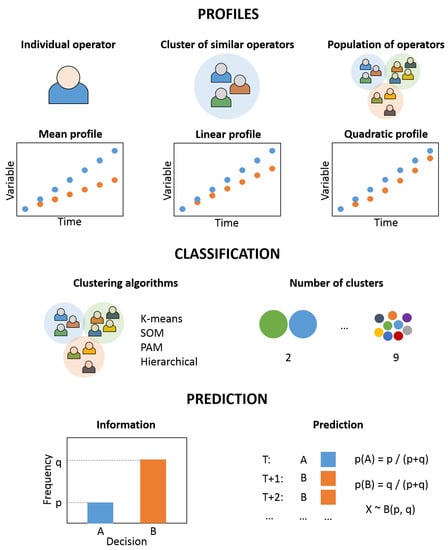
One of the active challenges in multi-robot missions is related to managing operator workload and situational awareness. Currently, the operators are trained to use interfaces, but in the near future this can be turned inside out: the interfaces will adapt to operators so as to facilitate their tasks. To this end, the interfaces should manage models of operators and adapt the information to their states and preferences. This work proposes a videogame-based approach to classify operator behavior and predict their actions in order to improve teleoperated multi-robot missions. First, groups of operators are generated according to their strategies by means of clustering algorithms. Second, the operators’ strategies are predicted, taking into account their models. Multiple information sources and modeling methods are used to determine the approach that maximizes the mission goal. The results demonstrate that predictions based on previous data from single operators increase the probability of success in teleoperated multi-robot missions by 19%, whereas predictions based on operator clusters increase this probability of success by 28%.
J11: J.J. Roldán, V. Díaz-Maroto, J. Real, P.R. Palafox, J. Valente, M. Garzón and A. Barrientos. Press start to play: classifying multi-robot operators and predicting their strategies through a videogame. Robotics, 8 (3), 53-67, 2019. Impact Factor (Scopus, 2018): 1.53, Q2. Article
Subscribe to:
Posts (Atom)