Tuesday, October 10, 2017

SwarmCity: monitoring future cities with intelligent flying swarms

Ladies and gentlemen, let me present you... SwarmCity Project!


Future cities will be bigger and their management more complex, posing challenges related to the traffic, management of resources, maintenance of green zones, pollution, etc. The aim of this project is to provide a tool to collect the relevant information of these cities to allow their authorities to make correct and efficient decisions. The proposal goes further than the current solutions based on fixed sensors, making use of an aerial robot swarm to obtain information at desired locations and times. The work is focused on the development of swarming algorithms to solve complex tasks through the combination of simple individual behaviors, as well as data mining techniques and immersive interfaces for processing and visualizing the information. Moreover, the scenario will be used as a testbed for new algorithms designed to create an emergent and distributed intelligence that will learn from the environment.


In other words, SwarmCity is the sum of a smart city, a robot swarm and a control interface:

  • The smart city has been developed by using Unity game engine. It is a simulator of a scaled city that includes traffic, pedestrians, garbage, climate and pollution. It is used not only as a view tool but also as a data source.
  • The robot swarm has to cover the city collecting data about the traffic jams, people crowds, contaminant emissions... For this purpose, we are going to study behavior-based architectures, multiple techniques of optimization, game theoretical decision making...
  • The control interface must allow the operators to monitor the state of the city, as well as to configure the swarm. For this purpose, we are going to explore data mining techniques to discover information, machine learning algorithms to adapt it to operator and immersive technologies to show it in a easy to understand way.

Saturday, September 9, 2017

JA2017: Jornadas de Automática 2017


We have participated in the XXXVIII Jornadas de Automática of Gijón on September 6-8th 2017 with a paper and a poster.

Hemos participado en las XXXVIII Jornadas de Automática de Gijón del 6 al 8 de septiembre de 2016 con un artículo y un póster.  

E. Peña Tapia, J.J. Roldán, M. Garzón, A. Martín Barrio and A. Barrientos. "Interfaz de Control para un Robot Manipulador mediante Realidad Virtual". XXXVIII Jornadas Nacionales de Automática. Gijón, September 6-8th 2017.


Saturday, August 26, 2017

TRADR Summer School 2017


I have taken part in the TRADR Summer School 2017. This course was organized by the TRADR european project and took place in the facilities of TNO in Utrecht (Netherlands). There I have learnt a lot of things about human-robot teaming, robot search and rescue... And I have had a good time!

He participado en la TRADR Summer School 2017. Este curso fue organizado por el proyecto europeo TRADR y tuvo lugar en las instalaciones del TNO en Utrecht (Países Bajos). Allí he aprendido un montón de cosas sobre equipos entre humanos y robots, búsqueda y rescate con robots... ¡Y me lo he pasado muy bien!

Saturday, July 29, 2017

Multi-Robot Interfaces and Operator Situational Awareness: Study of the Impact of Immersion and Prediction


Multi-robot missions are a challenge for operators in terms of workload and situational awareness. These operators have to receive data from the robots, extract information, understand the situation properly, make decisions, generate the adequate commands, and send them to the robots. The consequences of excessive workload and lack of awareness can vary from inefficiencies to accidents. This work focuses on the study of future operator interfaces of multi-robot systems, taking into account relevant issues such as multimodal interactions, immersive devices, predictive capabilities and adaptive displays. Specifically, four interfaces have been designed and developed: a conventional, a predictive conventional, a virtual reality and a predictive virtual reality interface. The four interfaces have been validated by the performance of twenty-four operators that supervised eight multi-robot missions of fire surveillance and extinguishing. The results of the workload and situational awareness tests show that virtual reality improves the situational awareness without increasing the workload of operators, whereas the effects of predictive components are not significant and depend on their implementation.

Las misiones multi-robot suponen un reto para los operadores en términos de carga de trabajo y conciencia de la situación. Los operadores tienen que recibir los datos de los robots, extraer la información, entender la situación, tomar decisiones, generar los comandos adecuados y enviarlos a los robots. Las consecuencias de una carga de trabajo excesiva o una falta de conciencia de la situación pueden variar desde ineficiencias hasta accidentes. Este trabajo se centra en el estudio de las interfaces de operador del futuro para sistemas multi-robot, teniendo en cuenta interacciones multimodales, dispositivos inmersivos, capacidades predictivas y paneles adaptativos. En concreto, se han diseñado y desarrollado cuatro interfaces: una convencional, otra convencional predictiva, una de realidad virtual y otra de realidad virtual predictiva. Las cuatro interfaces se han validado con el rendimiento de veinticuatro operadores en la supervisión de ocho misiones multi-robot de vigilancia y extinción de incendios. Los resultados de las encuestas de carga de trabajo y conciencia de la situación muestran que la realidad virtual mejora la conciencia de la situación sin incrementar la carga de trabajo de los operadores, mientras que los efectos de los componentes predictivos no son significativos y dependen de su implementación.


J.J. Roldán, E. Peña-Tapia, A. Martín-Barrio, M.A. Olivares-Méndez, J. del Cerro and A. Barrientos. “Multi-Robot Interfaces and Operator Situational Awareness: Study of the Impact of Immersion and Prediction”. Sensors, 17(8), 1720. 2017. Impact Factor (2016): 2.677. Article

Sunday, June 11, 2017

JNR2017: Jornadas de Robótica 2017


I have taken part in the Jornadas Nacionales de Robótica that took place in Valencia on June 8-9th 2017. I have presented the PRIC Project, which is about the use of robots to protect critical infrastructures and is being developed by my research group.

He participado en las Jornadas Nacionales de Robótica que tuvieron lugar en Valencia el 8 y 9 de junio de 2017. He presentado el Proyecto PRIC (Protección Robotizada de Infraestructuras Críticas), que está siendo desarrollado por la gente de mi grupo de investigación.

J.J. Roldán, M. Garzón, J. de León, D. Garzón-Ramos, A. Martín-Barrio, S. Terrile, P. García-Aunon, J. del Cerro, C. Rossi and A. Barrientos. Proyecto PRIC: Protección Robotizada de Infraestructuras Críticas. Jornadas Nacionales de Robótica. Valencia, June 8-9th 2017. Article

Wednesday, May 31, 2017

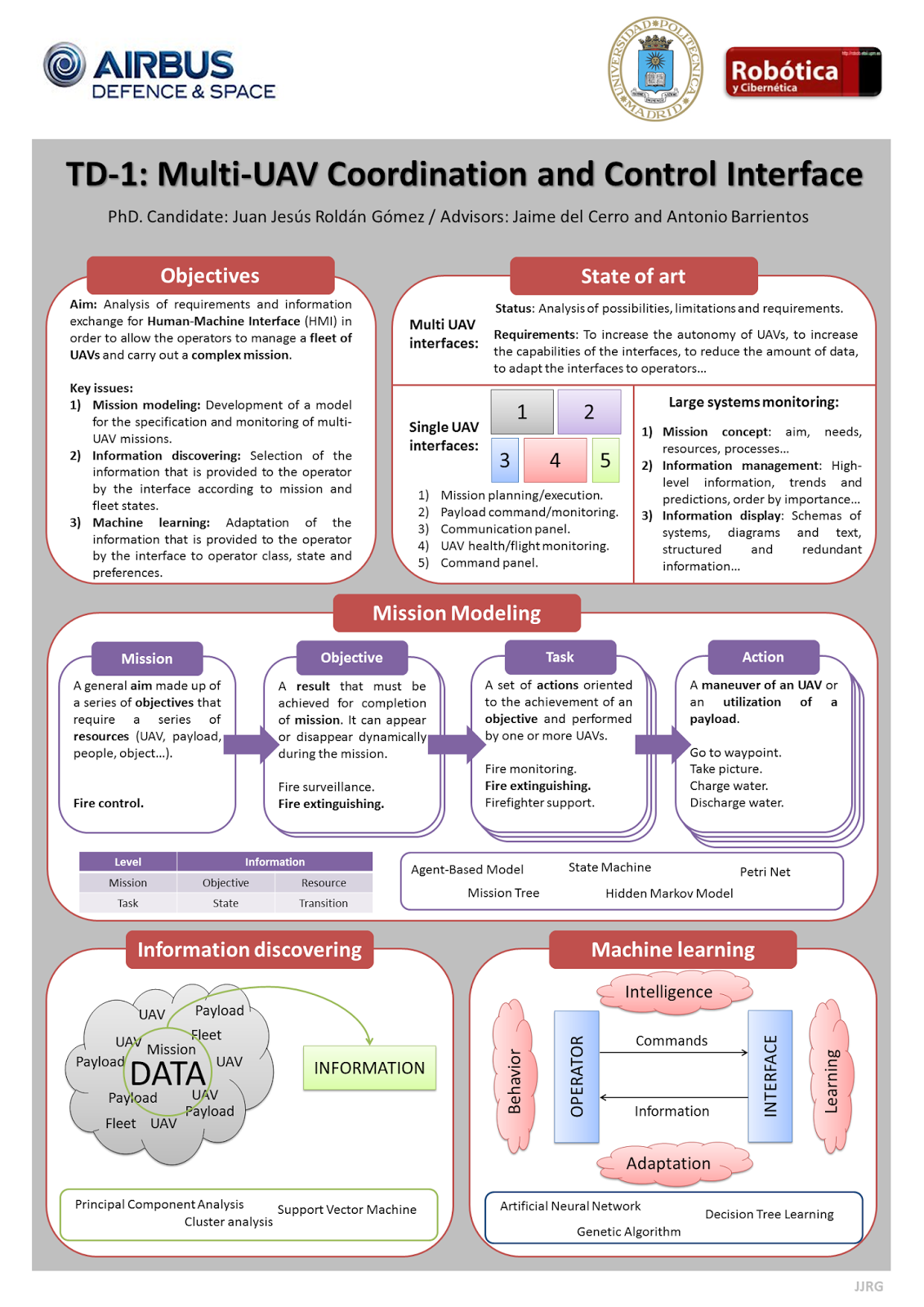
Thesis: Multi-UAV Coordination and Control Interface

The thesis is supported by the Robotics and Cybernetics Research Group (RobCib) of the Centre for Automation and Robotics (CAR) and framed in the project SAVIER (Situational Awareness Virtual Environment) of Airbus Defence and Space.

The pass from single-UAV to multi-UAV missions poses a set of challenges, such as to increase the autonomy of fleets and to reduce the workload of operators. This thesis aims to manage the information for a Human-Machine Interface (HMI) in order to allow a single operator to manage a fleet of UAVs and carry out a complex mission. Specifically, the thesis has the following objectives: 

1) Mission modeling: Development of a model for the specification and monitoring of multi-UAV missions.

2) Information discovery: Selection of the information that is provided to the operator by the interface according to mission and fleet states.

3) Machine learning: Adaptation of the information that is provided to the operator by the interace to operator class, state and preferences.

*     *     *

La tesis está apoyada por el Grupo de Robótica y Cibernética (RobCib) del Centro de Automática y Robótica (CAR) y enmarcada en el proyecto SAVIER (Situational Awareness Virtual Environment) de Airbus Defence and Space.

El paso de misiones de un solo UAV a misiones con múltiples UAVs plantea una serie de retos, como incrementar la autonomía de las flotas y reducir la carga de trabajo de los operadores. Esta tesis busca gestionar la información en una Interfaz Humano-Máquina para permitir a un solo operador gestionar una flota de operadores y llevar a cabo una misión compleja. Específicamente, la tesis tiene los siguientes objetivos:

1) Modelado de misiones: Desarrollo de un modelo para la especificación y la monitorización de misiones multi-UAV.

2) Descubrimiento de información: Selección de la información que la interfaz proporciona al operador según los estados de la misión y la flota.

3) Aprendizaje automático: Adaptación de la información que la interfaz proporciona al operador a la clase, estado y preferencias del mismo.

Poster 2014:

Poster 2015:

 Poster 2016:

Poster 2017:

Sunday, May 28, 2017

ROSBook2: A chapter about ROS in Multi-robot Systems


We have contributed with a chapter to the book Robot Operating System (ROS): The Complete Reference (Volume 2). Our chapter is entitled Using ROS in Multi-robot Systems: Experiences and Lessons Learned from Real-World Field Tests and describes our experiences with ROS and multi-robot missions in areas such as surveillance, environmental monitoring, agriculture...

Hemos contribuido con un capítulo al libro Robot Operating System (ROS): The Complete Reference (Volume 2). Nuestro capítulo se titula Using ROS in Multi-robot Systems: Experiences and Lessons Learned from Real-World Field Tests y describe nuestras experiencias con misiones multi-robot y ROS en áreas como la vigilancia, monitorización ambiental, agricultura... 

M. Garzón, J. Valente, J. J. Roldán, D. Garzón-Ramos, J. de León, A. Barrientos and J. del Cerro. Using ROS in Multi-robot Systems: Experiences and Lessons Learned from Real-World Field Tests. Robot Operating System (ROS), Volume 2, pp. 449-483. Springer International Publishing, 2017.